Today, I decided to take the implicit associations test. Some describe the tool as an accurate way to determine one's personal biases based on their association with words and a select category of people. Others, however, critique the test as extremely flawed. Because I am not nearly credentialed enough to have the utmost opinion on it, I don't have the answer as to the accuracy of the test.
You can read up on the scientific basis of it on your own and if you understand these kinds of things, feel free to chime in your educated opinion. You can even review some of the test's data. I also will provide you with two critiques from professionals, available here and here.
Regardless, I am a firm believer that ALL of us have prejudices and biases. They form from media, government, our social circles, our families, our religions, among many other things. The trick is confronting and dealing with these prejudices instead of trying to pretend they do not exist. The longer we hide our prejudices, the longer they will continue to control the world and the way we interact with others. I am not going to write an essay on implicit bias or prejudices today. But am I going to say this simply:
We MUST understand the difference between overt -isms and passive -isms. By -isms, I mean heterosexism, racism, sexism, ableism, cissexism and the many more -isms that make up our society today. Everyone knows that the Westboro Baptist Church and Kim Davis are overt heterosexists. Everyone knows that David Duke and the Neo-Nazi regime are overt racists. These tests are not for people like them (although I would be curious to see how they would score.) Instead, these are for the passive -ists. Our mothers, fathers, teachers, friends, neighbors and most importantly ourselves. We must be ready and willing to tackle our own biases, especially if we are going to consider ourselves an "ally".
Anyway, I am going to share my results and my thoughts on them. If you decide to take the test and want to discuss them with me, feel free. You don't have to do so publicly. You can e-mail me at archangeladvocacy@gmail.com or DM me on Twitter @archangeltampa.
1st Test--Heterosexism
I am a proud, out gay man. According to my IAT, I have a slight automatic preference for gay people over straight people.
I can say that I was surprised it was "slight". I expected to aim at a stronger preference. I enjoy the company of gay men and lesbians. That's no secret. I wasn't completely blown away by the results either. Mostly indifferent about it. I know that I have heterosexist tendencies and with heterosexual as the default, it is difficult to unlearn. But as I grow and become more self-aware, I have become a lot less favorable of heteronormative belief systems, in many ways, but that's a topic for another day.
According to their web data, only 8% ranked into the "slight automatic preference". The majority of the respondents ranked at a "strong automatic preference" for straight people. This just isn't surprising at all. Straight is the default and for many, it is the normal. Only 18% of respondents ranked neutral.
2nd Test--Gender-Science Association
So, in this section, I found that, according to the test, I have a slight bias association with men in science and women in the liberal arts. This is a form of sexism in which people associate men with positions in medicine, mathematics, anthropology and similar sciences and women in positions in education, art, music and theater.
18% of respondent where on par with where I ranked, with a more automatic association with men in science and women in liberal arts. I was surprised to see that the majority of respondents were only moderate in this assumption rather than strong but nonetheless, the overwhelming majority ranked in an association of men in science. Very few ranked in the opposite belief system.
3rd Test--Colorism
According to this test, I show a slight automatic preference for people with lighter skin than I do with darker skinned people. Colorism is a problem that is separate from racism and exists in every race. Our media is likely one of the largest contributors to our colorist belief systems, with light-skinned people hailed as the exemplary beauties and dark-skinned as not so beautiful. I can't say I was entirely surprised by my results. I can't remember a time where I ever "actively" displayed colorism but the fact is, I know I have prejudices, like everyone else. So, this is something for me to think about.
Not surprisingly again, the majority of respondents showed a preference to light skin verses dark skin. 17% aligned with my results in a slight preference response whereas 19% were neutral. Once again, the data shows that very few people had even a slight preference to dark skinned individuals.
4th Test--Racism
According to the data, I scored with no specific preference to black people or white people. Does a person in this category mean they are not racist? I wouldn't say that at all. I think that racism is a very complex matter and is a part of all of our daily lives as white people. The data doesn't exonerate me of white privilege nor should anyone construe it so.
Are you noticing a trend yet? Once again, the majority of the respondents had strong favor towards white people. Only 18% of respondents aligned with a neutral stance and a very small margin had preference toward black people.
What this data shows, to me, is exactly what social justice activists, many who don't hold science degrees of any kind, have been talking about. It's that implicit bias that continues to rear it's ugly head. And we continue to refuse to address it because we don't want to be perceived as racist, sexist and heterosexist.
But we do hold these biases. And it is our jobs, and not the jobs of the people of the marginalized groups, to tackle them. We can't do it with coddling and with deflection.
I personally would have loved to see these results 5 years ago. I think I have grown in my time since then and believe that I would have scored with much stronger biases back then. It remains to be seen how I would score 5 years from now.
Self-examination is a crucial aspect of growth, not just as an individual but as a society. So, if you dare, take the tests. See how you score. See what parts of your biases you need to truly examine and reflect on.
I don't have the solutions for ending these prejudices and biases. But I know that ignoring them isn't it.
Much love,
ArchAngel O:)
Thank you to Reginald Cunningham for your article that inspired this venture.
Just the world from my viewpoint. All content is the opinion of my own. If you feel your content has been wrongfully distributed on this blog without proper credit, please e-mail archangeladvocacy@gmail.com. Opinions in blog reflect my opinion and are not representative of any organization or cause.
Thursday, December 8, 2016
Wednesday, December 7, 2016
Pro Choice Matters
For years, I struggled with being open about being pro-choice. Many people, including "liberals" have very strong anti-choice feelings. It usually stems from a viewpoint of religion or a false sense of morality.
Today, I am very open in my stance on reproductive justice, including but not limited to abortion.
Abortion is not a fun subject to discuss. It is emotionally charged and highly stigmatized. But the longer we keep silent about it, the longer it will continue to be stigmatized. As a cis male, I will never experience a situation where I may need an abortion. That is a form of privilege, decided solely by my biological sex.
Today, the Ohio House passed a Senate Bill known as the Heartbeat Bill. In true conservative fashion, it is a bill that is designed to outlaw abortion after six weeks, when supposedly a heartbeat can be heard. Aside from the fact that this violates Roe v. Wade, which made abortion legal in the United States, it is a serious human rights issue and a very concerning matter.
"State Senate President Keith Faber, a Republican, said the twice-defeated bill came back up again because of Donald Trump’s presidential victory and the expectation he will fill Supreme Court vacancies with justices who are more likely to uphold stricter abortion bans."
Now that we are facing not only a Republican President but also a Republican controlled Legislative branch and, after the President makes his appointment, a Republican controlled Judicial branch, we are at very serious risk of regression on this matter.
Conservatives like to believe outlawing abortion will stop it. But pre-Roe v. Wade America tells a very different (and very gory) story.
In this article by Jennifer Gerson Uffalussy, some of the realities of pre-Roe abortion come to light.
"Surveys from the 1950s approximate somewhere between 200,000 and 200 million abortion performed illegally each year in the U.S. Grimes says that, at this time, it is safe to estimate that four women a day died in America as a consequence of illegal abortion. “That’s a huge amount of suffering,” he says."
Uffalussy is citing David Grimes, a medical doctor, who served as an OBY-GYN and as an epidemiologist for the CDC in relation to abortion in the 1970's.
200 million illegally performed abortions. At what cost?
Morality?
Ethics?
"Now 72 years old, Ronnie Konner was 19 when she found herself pregnant by her “incredibly narcissistic” sculptor boyfriend. “He couldn’t have been less interested in me or my problem — or what he considered my problem,” she recalls. “Or going with me to take care of it.”
After overhearing a college classmate mention abortion, Konner was then able to secure a phone number. The person on the other end told her to go to the California-Mexico border holding sunglasses in her left hand — a sign to the driver that she was to be picked up and driven to Mexico for an abortion. The cost was $300."
That's a very scary picture. That sounds like a drug-deal situation. Imagine the vulnerability many women faced in this "back-alley" abortion. Untrained "clinicians". No access to medical care before or after. On top of that, they were literally in danger of crimes against them by these sketchy providers.
"Should abortion again become a states’ rights issue, like it was before Roe passed in 1973, women might find themselves back in the position they were in the early 1970s, when, Grimes explains, 80 percent of all abortions were performed in two states: New York and California."
"The legalization of abortion is also responsible for the decrease in medical costs across the country when it comes to surgical procedures. Until Roe v. Wade, all surgeries were performed in a hospital. After Roe, freestanding outpatient clinics such as Planned Parenthood emerged, proving to be safer and more cost-effective than a hospital for several reasons."
The fact is, no matter how you spin it:
Criminalization does not decrease or eliminate abortion, it only makes it costlier and deadlier.
Abortion is a public health issue.
Abortion is a woman's choice and right.
The conservative rhetoric about abortion is dangerous. Certainly, if you wanted to, you could research the number of fatalities that resulted from abortion. When it is criminalized, it also increases costs of our policing and already overburdened criminal justice system.
It doesn't matter if you like abortion. Even if you do not support it yourself. We have to live in reality--and reality shows us that outlawing abortion is very dangerous.
Stand up and support reproductive rights.
Much love,
ArchAngel O:)
Today, I am very open in my stance on reproductive justice, including but not limited to abortion.
Abortion is not a fun subject to discuss. It is emotionally charged and highly stigmatized. But the longer we keep silent about it, the longer it will continue to be stigmatized. As a cis male, I will never experience a situation where I may need an abortion. That is a form of privilege, decided solely by my biological sex.
Today, the Ohio House passed a Senate Bill known as the Heartbeat Bill. In true conservative fashion, it is a bill that is designed to outlaw abortion after six weeks, when supposedly a heartbeat can be heard. Aside from the fact that this violates Roe v. Wade, which made abortion legal in the United States, it is a serious human rights issue and a very concerning matter.
"State Senate President Keith Faber, a Republican, said the twice-defeated bill came back up again because of Donald Trump’s presidential victory and the expectation he will fill Supreme Court vacancies with justices who are more likely to uphold stricter abortion bans."
Now that we are facing not only a Republican President but also a Republican controlled Legislative branch and, after the President makes his appointment, a Republican controlled Judicial branch, we are at very serious risk of regression on this matter.
Conservatives like to believe outlawing abortion will stop it. But pre-Roe v. Wade America tells a very different (and very gory) story.
In this article by Jennifer Gerson Uffalussy, some of the realities of pre-Roe abortion come to light.
"Surveys from the 1950s approximate somewhere between 200,000 and 200 million abortion performed illegally each year in the U.S. Grimes says that, at this time, it is safe to estimate that four women a day died in America as a consequence of illegal abortion. “That’s a huge amount of suffering,” he says."
Uffalussy is citing David Grimes, a medical doctor, who served as an OBY-GYN and as an epidemiologist for the CDC in relation to abortion in the 1970's.
200 million illegally performed abortions. At what cost?
Morality?
Ethics?
"Now 72 years old, Ronnie Konner was 19 when she found herself pregnant by her “incredibly narcissistic” sculptor boyfriend. “He couldn’t have been less interested in me or my problem — or what he considered my problem,” she recalls. “Or going with me to take care of it.”
After overhearing a college classmate mention abortion, Konner was then able to secure a phone number. The person on the other end told her to go to the California-Mexico border holding sunglasses in her left hand — a sign to the driver that she was to be picked up and driven to Mexico for an abortion. The cost was $300."
That's a very scary picture. That sounds like a drug-deal situation. Imagine the vulnerability many women faced in this "back-alley" abortion. Untrained "clinicians". No access to medical care before or after. On top of that, they were literally in danger of crimes against them by these sketchy providers.
"Should abortion again become a states’ rights issue, like it was before Roe passed in 1973, women might find themselves back in the position they were in the early 1970s, when, Grimes explains, 80 percent of all abortions were performed in two states: New York and California."
"The legalization of abortion is also responsible for the decrease in medical costs across the country when it comes to surgical procedures. Until Roe v. Wade, all surgeries were performed in a hospital. After Roe, freestanding outpatient clinics such as Planned Parenthood emerged, proving to be safer and more cost-effective than a hospital for several reasons."
The fact is, no matter how you spin it:
Criminalization does not decrease or eliminate abortion, it only makes it costlier and deadlier.
Abortion is a public health issue.
Abortion is a woman's choice and right.
The conservative rhetoric about abortion is dangerous. Certainly, if you wanted to, you could research the number of fatalities that resulted from abortion. When it is criminalized, it also increases costs of our policing and already overburdened criminal justice system.
It doesn't matter if you like abortion. Even if you do not support it yourself. We have to live in reality--and reality shows us that outlawing abortion is very dangerous.
Stand up and support reproductive rights.
Much love,
ArchAngel O:)
Monday, December 5, 2016
Boycotting Corporatism
In my previous post, I critiqued an injustice boycott put together by an "activist". In this writing, I will discuss a personal boycott that I am doing, and why I am doing it. If I had a platform as viable as the "activist" mentioned above, I would definitely roll out this as a "strategy" to effective boycotting of corporatism in America.
Since probably the only people that read this is my own parents (hi mom) if even them, I will just have to "lead by own example". I do not need the masses to come together to hold myself accountable and that is, in part, one of my goals in 2017 as I move forward as an aware, well-rounded individual.
So, the first thing is understand what I mean by Corporatism. Corporatism is the philosophy that government and corporations are in bed together. I have heard the term used interchangeably with hypercapitalism. I really don't care what you call it. What it is, is exactly what we are living in.
There are many honest and genuine critiques of capitalism as whole. All of these critiques are valid. But truthfully, I believe even capitalism could be checked and balanced, if it weren't for this hypercapitalistic In another post, I will discuss why I think America should operate, separate from corporations, but I do not want to derail.
Now, one thing I am is pragmatic. I understand that it is absolutely impossible to boycott all corporations. Even if 100% of all my purchases were from small businesses, I would still indirectly support corporations. Where do they get their materials? Products? Office buildings even?
It just isn't possible to totally disconnect.
It is, however, possible to target some of the major offenders that damage our economy and truly harm people. So, in order to do that, I will outline some items of "offenses" that are most egregious. I will then independently research different major corporations to find out where they fit on this scale of ethics.
1. I will divest from Corporations who do not within their bylaws support protections of their personnel and customers on the basis of gender identity and sexual orientation.
The Civil Rights Act of 1964 requires (technically--but that's another story) that all businesses hire, serve, promote etc. people of all genders, religions, races, national origins and colors. Later legislation was introduced to "protect" people with disabilities and those over the age of 40.
I am well aware that these laws are often not followed---and that is a topic to be addressed. But the fact is, they cannot blatantly discriminate on those categories and that is a step.
Many states, including Florida, however, do not protect LGBTQ customers or employees from adverse job action.
It isn't about whether or not the company WILL discriminate but rather that they are OKAY with allowing it, if it suits them.
For this reason, I must make a conscious choice to personally divest from these organizations.
2. I will divest from Corporations who largely benefit from free prison labor.
First, I should mention, it is probably impossible to completely boycott companies that benefit from this labor. In short, it's probably every company in some way or some degree. However, the goal is identify companies that largely benefit from it or have this embedded in their practices or supply chains.
3. I will divest from Corporations who largely benefit from overseas slave labor/trafficking.
Again, this is probably not something we can positively, fully avoid. However, some companies undoubtedly benefit from this practice. As a result, I must make the conscious choice to not support these businesses.
4. I will divest from Corporations who chose to support/donate to organizations aimed at discriminating or harming the LGBT community.
5. I will divest from Corporations who directly support the National Rifle Association.
6. I will divest from Corporations who avoid paying a large portion of their taxes owed.
This one will probably prove to be one of the mostly challenging feats to fight. But perhaps it can be done!
In turn, however, I will need to shift my investments elsewhere, whenever possible. This will get tricky as the different criterion intersect.
1. I will invest in local businesses whenever possible, ideally locally owned but when not available, locally owned franchises.
2. I will invest in companies that openly protect and support LGBT people.
3. I will invest in companies that have (in general) good records of treating their employees well, including in pay, in avoiding discrimination and in working conditions (including safety.)
4. I will invest in companies that largely operate in the United States and employ Americans.
This is going to be a challenge for sure. Identifying all these categories and making the conscious effort to truly follow-through. And certainly, it doesn't cover all the bases we need to combat the Corporatism. But as they say, "vote with your dollars".
As I identify companies that meet the criterion above, both in invest and divest, I will mention them publicly. I will also write to each company so they know why I am not purchasing from them.
I know that I, individually, do not have the power to damage their bottom lines. But I do believe that every "drop in the bucket" matters.
And who knows, maybe this will inspire others to do the same.
Tell me? Any criterion I missed that I should have strongly considered? Any companies you recommend getting the 2017 axe? Any companies that deserve the patronage?
I am all ears!
Much love,
ArchAngel O:)
Since probably the only people that read this is my own parents (hi mom) if even them, I will just have to "lead by own example". I do not need the masses to come together to hold myself accountable and that is, in part, one of my goals in 2017 as I move forward as an aware, well-rounded individual.
So, the first thing is understand what I mean by Corporatism. Corporatism is the philosophy that government and corporations are in bed together. I have heard the term used interchangeably with hypercapitalism. I really don't care what you call it. What it is, is exactly what we are living in.
There are many honest and genuine critiques of capitalism as whole. All of these critiques are valid. But truthfully, I believe even capitalism could be checked and balanced, if it weren't for this hypercapitalistic In another post, I will discuss why I think America should operate, separate from corporations, but I do not want to derail.
Now, one thing I am is pragmatic. I understand that it is absolutely impossible to boycott all corporations. Even if 100% of all my purchases were from small businesses, I would still indirectly support corporations. Where do they get their materials? Products? Office buildings even?
It just isn't possible to totally disconnect.
It is, however, possible to target some of the major offenders that damage our economy and truly harm people. So, in order to do that, I will outline some items of "offenses" that are most egregious. I will then independently research different major corporations to find out where they fit on this scale of ethics.
1. I will divest from Corporations who do not within their bylaws support protections of their personnel and customers on the basis of gender identity and sexual orientation.
The Civil Rights Act of 1964 requires (technically--but that's another story) that all businesses hire, serve, promote etc. people of all genders, religions, races, national origins and colors. Later legislation was introduced to "protect" people with disabilities and those over the age of 40.
I am well aware that these laws are often not followed---and that is a topic to be addressed. But the fact is, they cannot blatantly discriminate on those categories and that is a step.
Many states, including Florida, however, do not protect LGBTQ customers or employees from adverse job action.
It isn't about whether or not the company WILL discriminate but rather that they are OKAY with allowing it, if it suits them.
For this reason, I must make a conscious choice to personally divest from these organizations.
2. I will divest from Corporations who largely benefit from free prison labor.
First, I should mention, it is probably impossible to completely boycott companies that benefit from this labor. In short, it's probably every company in some way or some degree. However, the goal is identify companies that largely benefit from it or have this embedded in their practices or supply chains.
3. I will divest from Corporations who largely benefit from overseas slave labor/trafficking.
Again, this is probably not something we can positively, fully avoid. However, some companies undoubtedly benefit from this practice. As a result, I must make the conscious choice to not support these businesses.
4. I will divest from Corporations who chose to support/donate to organizations aimed at discriminating or harming the LGBT community.
5. I will divest from Corporations who directly support the National Rifle Association.
6. I will divest from Corporations who avoid paying a large portion of their taxes owed.
This one will probably prove to be one of the mostly challenging feats to fight. But perhaps it can be done!
In turn, however, I will need to shift my investments elsewhere, whenever possible. This will get tricky as the different criterion intersect.
1. I will invest in local businesses whenever possible, ideally locally owned but when not available, locally owned franchises.
2. I will invest in companies that openly protect and support LGBT people.
3. I will invest in companies that have (in general) good records of treating their employees well, including in pay, in avoiding discrimination and in working conditions (including safety.)
4. I will invest in companies that largely operate in the United States and employ Americans.
This is going to be a challenge for sure. Identifying all these categories and making the conscious effort to truly follow-through. And certainly, it doesn't cover all the bases we need to combat the Corporatism. But as they say, "vote with your dollars".
As I identify companies that meet the criterion above, both in invest and divest, I will mention them publicly. I will also write to each company so they know why I am not purchasing from them.
I know that I, individually, do not have the power to damage their bottom lines. But I do believe that every "drop in the bucket" matters.
And who knows, maybe this will inspire others to do the same.
Tell me? Any criterion I missed that I should have strongly considered? Any companies you recommend getting the 2017 axe? Any companies that deserve the patronage?
I am all ears!
Much love,
ArchAngel O:)
Saturday, December 3, 2016
Ethics in Therapy for LGBT Clients
Therapy has been one of the most powerful aspects of my life. Through guided therapy, I have developed new life skills that have made my life easier to manage, in both my highest moments and my lowest moments. While I certainly do not believe therapy is the end-all be-all nor do I believe it is for everyone, I do believe it is effective in many cases.
Lesbian, gay, transgender, bisexual and otherwise classified "queer" people often need therapy. This has to do with, in short, the sociological adversities our gender identity or sexual orientation brings us. We face discrimination and hate, often in the name of religion and Godliness.
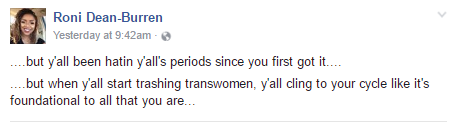
My friend, who is an activist and powerful voice in the community both personally and digitally, decided to take to Facebook yesterday to discuss the importance of trans inclusion in feminism. Many people chimed in with support, which it was not subject to debate, but one specific commenter decided to dissent. That did not go over well for this commenter. If you do not follow Roni Dean-Burren on Facebook, you should. You can also check her out on Twitter @Roni_Dean or her website www.ronideanburren.com.
It started out simply enough:
NOTE: Roni intended to space between trans and women but forgot to do so and is currently unable to edit the post due to a Facebook temporary ban.
This is when Melissa Pulido, an alleged student going to school for mental health work, decided to chime in uninvited.
Now, if you are trans, or are an activist to transgender people, you understand why this comment is problematic. But naturally, as it usually does, the situation gets worse.
Lesbian, gay, transgender, bisexual and otherwise classified "queer" people often need therapy. This has to do with, in short, the sociological adversities our gender identity or sexual orientation brings us. We face discrimination and hate, often in the name of religion and Godliness.
My friend, who is an activist and powerful voice in the community both personally and digitally, decided to take to Facebook yesterday to discuss the importance of trans inclusion in feminism. Many people chimed in with support, which it was not subject to debate, but one specific commenter decided to dissent. That did not go over well for this commenter. If you do not follow Roni Dean-Burren on Facebook, you should. You can also check her out on Twitter @Roni_Dean or her website www.ronideanburren.com.
It started out simply enough:
NOTE: Roni intended to space between trans and women but forgot to do so and is currently unable to edit the post due to a Facebook temporary ban.
This is when Melissa Pulido, an alleged student going to school for mental health work, decided to chime in uninvited.
Now, if you are trans, or are an activist to transgender people, you understand why this comment is problematic. But naturally, as it usually does, the situation gets worse.
Pulido is clearly uninformed about the nature of the sociological people in the transgender community face. Suicide is a factor in the transgender culture but it is not because they are transgender. It is because of the stigma and discrimination with being transgender. It is because of the discrimination and disparate treatment of being transgender. But not for being transgender itself. Also, she referred to transgender as a "lifestyle choice".
Let's talk about lifestyle choices.
A diet is a lifestyle choice. Fashion is a lifestyle choice. The way you spend your money is a lifestyle choice. Your hobbies are lifestyle choices. Gender identity nor sexual orientation is a lifestyle choice.
As if it wasn't bad enough, it got worse above. Here, Pulido takes it another level. Now, she is no longer spewing ignorance, she is now claiming she is studying the subject of mental health. And because of her studies, she has determined in her "expert opinion", that gays and transgender people all have deep "seated" [sic] issues and that is why they are the way they are. She also referred to these orientations and identities as "unresolved issues."
As the conversation ran on, I wanted to know more about Pulido. I asked if she was a licensed mental health professional of any capacity to which she said no, that she is working on becoming one. Which is interesting because she claimed she already worked with patients and that was why she was more informed on the subject matter than myself, a gay man. (Interesting how that works isn't it?)
Now, if that wasn't troubling enough, this was probably the comment that truly ruffled my feathers.
If I, a gay man, do not like her opinion, I need to not worry about it because she is working on her degree? Actually, that is all the more reason I need to worry about it. Someone like her should not be anywhere near LGBTQ clients. In any capacity.
A quick Google search led me to Pulido's LinkedIn profile. She claimed on her profile she was studying at Lone Star College CyFair.
I am not about to tolerate someone like her completing a psychology program with that kind of ill-informed rhetoric being thrown around. So, I e-mailed the Dean of the program snapshots of her commentary and included all of my contact information. Should I get a response, I will share that on this blog.
Why is this important? With people like Mike Pence advocating for dangerous, out-dated and failed therapies like conversion therapy, it is all the more important that we have only ethically trained, licensed therapists performing therapy of LGBTQ clients.
Therapy, as I referenced before, can be extremely helpful and transformative. However, if applied unethically, or ill-informed, it can be dangerous and induce trauma that may never be fully reversed.
Much love,
ArchAngel O:)
Moving Forward
2016 was undoubtedly one of the most exciting, but exhausting, years politically. As with all presidential elections, you see a hype of energy surrounding politics expand as people aggrandize their opinions.
Politics is not something I am particularly new to, although I am not a seasoned veteran either. I can definitely say the 2016 election taught me an enormous amount and I am so grateful for that. So, before I discuss my personal goals and plans of actions for 2017 and moving forward, I want to discuss what I learned from the 2016 election:
1. We need to get boots on the ground for local elections and mid-term elections more effectively. Simply put, the presidential election sucks up too much energy. We need to focus where it matters the most.
2. Energy is too precious to be wasted. Some people can debate and learn new perspectives. Other people will gaslight and deflect. Learn who is who and only spend time engaging with actual people who want to learn and participate. Otherwise, you will burn yourself out.
3. Stand firm. I was an adamant supporter of Bernie Sanders. Many Democrats chastised me for this. I stood firmly in my beliefs. He wasn't perfect by any means but he had so much to offer and opened up some very important conversations. I did not stand down, even after the loss, and I don't intend to stand down in the future either.
Now, earlier today, Rhonda Ragsdale had engaged her Twitter account discussing what we can do it move forward, using the #whatcanwedo hashtag. I got to thinking about what needs to happen to move forward and I responded with a series of comments. To follow Rhonda, find her on Twitter @profragsdale.
1. Get involved in local grassroots activism designed to make changes locally.
Yes, of course we want to transform the world. But you have heard the saying, "Think globally, act locally." We must remember what we CAN do within our confines. Every little difference matters. Find a cause, or six causes, if you have the time and energy. Get involved in the group. Network with other members of the groups and find out what the goals are.
2. Support Brand New Congress and their initiative to flip the seats in 2018.
With the Republican Party in sole control of all facets of government now, we need to strategise to transform this in 2018. The only way to do that is to unseat many elected officials in the House and Senate. Go to www.brandnewcongress.org and donate money. If you know someone who you think is a leader in your community and can make true transformative change, nominate them.
3. Educate yourself about the topics of allyship you need to focus on.
If you aren't gay, you might want to follow the blog of a gay person to learn what their struggles and ideas are. If you aren't black, you might want to follow a black person to learn about their struggles. Etc. Piece of advice: Don't ask people how to be an ally unless they are a close, personal friend who you believe would want you to ask that. Marginalized people are exhausted trying to educate "allies" over and over again. Use the resources available and teach yourself. Use active listening. Remember, you do not always need to speak.
In specific to supporting black people in this activism, you can subscribe to www.safetypinbox.com to learn some ally steps. In addition to education and training, you also directly support black women with your money. You can learn more on their website. It was founded by black women activists, Leslie and Marissa, who have quite impressive track records of doing the work.
4. Amplify the voices of the marginalized.
Long gone on the days of allyship being trusted at the front and center. Simply put, allies have failed to truly make the impact that is needed for marginalized people. It is time for allies to step to the side and amplify the voices of the actual people who have the concerns. Aside from listening, share content from these activists. (Make sure you credit them). Read books by marginalized authors. Watch videos and listen to podcasts. Share these materials and what you learned. This way, when you engage your friends, family and politicians, you can actually reference material from the root of the causes, instead of speaking at the level of your own comfort and interests.
This certainly is not an exhaustive list of things that will need to happen moving forward. This is just the groundwork that I believe will work towards the change that we need.
In a future blog, I will address my personal, specific goals and plans of action in 2017. I will also utilize this blog as a tool of self-accountability to ensure I actually work to meet my goals.
Please: Feel free to share, comment and discuss anything you see here.
Much love,
ArchAngel O:)
Politics is not something I am particularly new to, although I am not a seasoned veteran either. I can definitely say the 2016 election taught me an enormous amount and I am so grateful for that. So, before I discuss my personal goals and plans of actions for 2017 and moving forward, I want to discuss what I learned from the 2016 election:
1. We need to get boots on the ground for local elections and mid-term elections more effectively. Simply put, the presidential election sucks up too much energy. We need to focus where it matters the most.
2. Energy is too precious to be wasted. Some people can debate and learn new perspectives. Other people will gaslight and deflect. Learn who is who and only spend time engaging with actual people who want to learn and participate. Otherwise, you will burn yourself out.
3. Stand firm. I was an adamant supporter of Bernie Sanders. Many Democrats chastised me for this. I stood firmly in my beliefs. He wasn't perfect by any means but he had so much to offer and opened up some very important conversations. I did not stand down, even after the loss, and I don't intend to stand down in the future either.
Now, earlier today, Rhonda Ragsdale had engaged her Twitter account discussing what we can do it move forward, using the #whatcanwedo hashtag. I got to thinking about what needs to happen to move forward and I responded with a series of comments. To follow Rhonda, find her on Twitter @profragsdale.
1. Get involved in local grassroots activism designed to make changes locally.
Yes, of course we want to transform the world. But you have heard the saying, "Think globally, act locally." We must remember what we CAN do within our confines. Every little difference matters. Find a cause, or six causes, if you have the time and energy. Get involved in the group. Network with other members of the groups and find out what the goals are.
2. Support Brand New Congress and their initiative to flip the seats in 2018.
With the Republican Party in sole control of all facets of government now, we need to strategise to transform this in 2018. The only way to do that is to unseat many elected officials in the House and Senate. Go to www.brandnewcongress.org and donate money. If you know someone who you think is a leader in your community and can make true transformative change, nominate them.
3. Educate yourself about the topics of allyship you need to focus on.
If you aren't gay, you might want to follow the blog of a gay person to learn what their struggles and ideas are. If you aren't black, you might want to follow a black person to learn about their struggles. Etc. Piece of advice: Don't ask people how to be an ally unless they are a close, personal friend who you believe would want you to ask that. Marginalized people are exhausted trying to educate "allies" over and over again. Use the resources available and teach yourself. Use active listening. Remember, you do not always need to speak.
In specific to supporting black people in this activism, you can subscribe to www.safetypinbox.com to learn some ally steps. In addition to education and training, you also directly support black women with your money. You can learn more on their website. It was founded by black women activists, Leslie and Marissa, who have quite impressive track records of doing the work.
4. Amplify the voices of the marginalized.
Long gone on the days of allyship being trusted at the front and center. Simply put, allies have failed to truly make the impact that is needed for marginalized people. It is time for allies to step to the side and amplify the voices of the actual people who have the concerns. Aside from listening, share content from these activists. (Make sure you credit them). Read books by marginalized authors. Watch videos and listen to podcasts. Share these materials and what you learned. This way, when you engage your friends, family and politicians, you can actually reference material from the root of the causes, instead of speaking at the level of your own comfort and interests.
This certainly is not an exhaustive list of things that will need to happen moving forward. This is just the groundwork that I believe will work towards the change that we need.
In a future blog, I will address my personal, specific goals and plans of action in 2017. I will also utilize this blog as a tool of self-accountability to ensure I actually work to meet my goals.
Please: Feel free to share, comment and discuss anything you see here.
Much love,
ArchAngel O:)
Welcome
Welcome!
The opinions in this blog are strictly my own and do not reflect or represent any organization or cause. In other words, I speak for myself.
I believe in credit. If for any reason you believe content on this blog belong to you or someone you know, please e-mail me immediately at archangeladvocacy@gmail.com so it can be corrected.
Although this forum is generally open, and I am not much of a fan of censorship, there are some "house rules":
1. Threats of violence towards any other individual, including but not limited myself, are not tolerated.
2. Keep it respectful. If you can't discuss like adults, it doesn't belong here. Take it outside.
3. You comment at your own risk. I am not responsible if you get an internet dragging from myself or another commenter. If you have a dissent, that's fine, but be prepared to back it up.
I can be found on Twitter at @archangeltampa
The opinions in this blog are strictly my own and do not reflect or represent any organization or cause. In other words, I speak for myself.
I believe in credit. If for any reason you believe content on this blog belong to you or someone you know, please e-mail me immediately at archangeladvocacy@gmail.com so it can be corrected.
Although this forum is generally open, and I am not much of a fan of censorship, there are some "house rules":
1. Threats of violence towards any other individual, including but not limited myself, are not tolerated.
2. Keep it respectful. If you can't discuss like adults, it doesn't belong here. Take it outside.
3. You comment at your own risk. I am not responsible if you get an internet dragging from myself or another commenter. If you have a dissent, that's fine, but be prepared to back it up.
I can be found on Twitter at @archangeltampa
Subscribe to:
Posts (Atom)